Physical Address
304 North Cardinal St.
Dorchester Center, MA 02124
Physical Address
304 North Cardinal St.
Dorchester Center, MA 02124
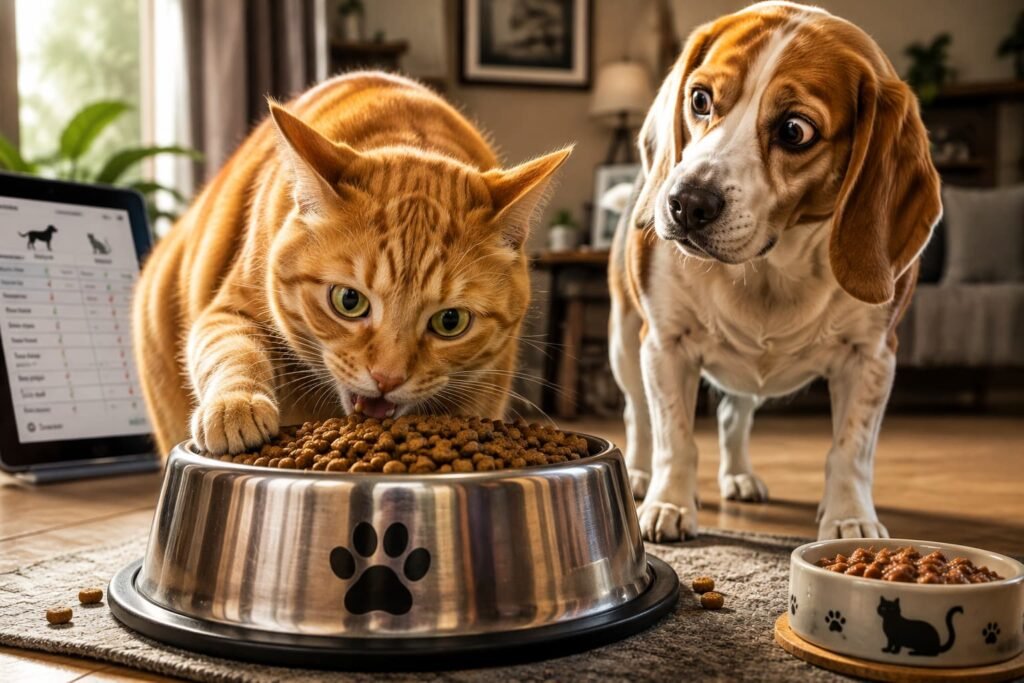
You turn around for two seconds and suddenly your cat is eating from the dog’s bowl.
Classic.
Cats are curious, opportunistic, and apparently convinced that every other animal’s dinner must taste better than their own. But if your cat steals a few bites of dog food, should you panic?
Usually, a small amount of dog food is unlikely to harm a healthy cat.
However, dog food is not designed to meet all of a cat’s unique nutritional requirements. Cats are obligate carnivores with dietary needs that are different from those of dogs.
So while an occasional bite of dog food is generally not an emergency, feeding dog food to a cat regularly can eventually lead to nutritional deficiencies and serious health problems.
Here’s what every cat owner should know.
Yes, cats can physically eat dog food, and an occasional small amount is generally not a problem for a healthy cat.
The important distinction is between eating a few bites and using dog food as a regular diet.
Dogs and cats have different nutritional requirements.
Dog food is formulated to meet the nutritional needs of dogs. Cat food is formulated specifically for cats.
That distinction matters because cats require certain nutrients that are either not required by dogs in the same amounts or are handled differently by their bodies.
A cat stealing a piece of kibble isn’t the same as a cat living on dog food.
If your cat sneaks into the dog’s bowl and eats a few pieces of kibble, there’s usually no reason to panic.
A healthy cat will generally tolerate a small amount of dog food without developing serious problems.
You may notice absolutely nothing.
In some cases, however, a cat with a sensitive stomach could experience mild digestive upset, particularly if it eats a large amount of unfamiliar food.
Possible signs include:
If symptoms are severe, persistent, or accompanied by weakness or other concerning signs, contact your veterinarian.
But if your cat simply stole three pieces of kibble and is now sitting on the couch pretending nothing happened, the situation is probably much less dramatic than your cat’s expression suggests.
The biggest problem is nutrition.
Cats have evolved as obligate carnivores, meaning animal-derived nutrients are particularly important to their physiology.
They require certain nutrients in their diet that dog foods may not provide in sufficient amounts.
One of the most important examples is taurine.
Taurine is an essential nutrient for cats.
Unlike dogs, cats have a limited ability to synthesize taurine, which means they need to obtain adequate amounts from their diet.
Taurine is important for normal heart function, vision, reproduction, and other physiological processes.
Commercial cat foods are formulated to provide taurine at levels appropriate for cats.
Dog foods are not necessarily formulated to meet feline taurine requirements.
A cat eating dog food occasionally is unlikely to become taurine deficient overnight.
But a diet consistently lacking adequate taurine can eventually cause serious health problems.
Cats have a limited ability to convert beta-carotene into active vitamin A.
As a result, they require preformed vitamin A in their diet.
Complete cat foods are formulated with this requirement in mind.
Dog foods may contain vitamin A, but they aren’t necessarily formulated to satisfy all of a cat’s specific nutritional requirements.
Again, the issue isn’t one stolen meal.
It’s long-term dietary inadequacy.
Cats have a limited ability to synthesize certain fatty acids, including arachidonic acid.
This fatty acid is therefore an important dietary requirement for cats.
Complete cat foods are designed to provide the nutrients cats need, including appropriate fatty acids.
Dog food isn’t necessarily formulated to meet those feline-specific requirements.
Cats generally require more dietary protein than dogs.
Their metabolism is adapted to using protein as an important energy source.
A dog food may contain plenty of protein and still not be ideal for a cat because nutritional adequacy isn’t determined by protein alone.
Cats need the right balance of amino acids, vitamins, minerals, fats, and other nutrients.
It’s a nutritional puzzle, not a protein popularity contest.
Cats don’t simply need “more meat.”
They need a carefully balanced combination of nutrients.
Commercial cat foods are designed to provide appropriate levels of essential amino acids, fatty acids, vitamins, and minerals.
A dog food may be completely adequate for a dog while being inadequate for a cat.
This is why pet food should be species-specific.
If you temporarily run out of cat food, a small amount of dog food is generally unlikely to harm a healthy adult cat.
However, it shouldn’t become the normal feeding plan.
If you can’t obtain appropriate cat food promptly, contact your veterinarian for guidance, particularly if your cat is a kitten, elderly, pregnant, nursing, or has an underlying medical condition.
Cats can also be particularly sensitive to prolonged periods without eating.
If your cat refuses food altogether, don’t assume it will simply eat when it gets hungry enough. Cats that stop eating can develop serious complications, including hepatic lipidosis, particularly if they are overweight.
Kittens have even more specific nutritional requirements because they’re growing rapidly.
They need a complete and balanced diet formulated specifically for growth.
Dog food should not be used as a regular food source for kittens.
A few stolen pieces aren’t likely to cause a nutritional crisis, but a kitten should be fed an appropriate kitten diet.
Some cats may appear to prefer dog food.
That doesn’t mean it’s nutritionally appropriate.
Cats can develop strong preferences for particular textures, smells, shapes, and flavors.
If your cat constantly raids the dog’s bowl, consider feeding the animals separately.
You can also feed the cat in a location the dog cannot access.
Cats often appreciate elevated feeding areas, although safety and accessibility should always be considered.
Not as a long-term feeding strategy.
Dogs and cats can live together perfectly well, but their nutritional requirements aren’t interchangeable.
Think of it like this:
A dog and a cat may both enjoy chicken.
That doesn’t mean they need the same diet.
A shared kitchen doesn’t require a shared nutritional blueprint.
This is when you should intervene.
If your cat regularly consumes dog food, it may gradually reduce its intake of nutritionally complete cat food.
Over time, this can increase the risk of nutritional deficiencies.
The consequences depend on how much dog food the cat eats, what type of dog food it is, and what other foods the cat consumes.
If your cat has been eating dog food regularly, talk to your veterinarian about the best way to return it to a complete feline diet.
If your cat repeatedly raids the dog’s bowl, several strategies can help.
Give the cat and dog their meals in separate areas.
Don’t leave food available all day if your cat has easy access to it.
Feeding at consistent times can make it easier to control who eats what.
Cats can sometimes be fed in a location the dog cannot reach.
For persistent food thieves, a selective-access feeder can prevent one pet from eating another pet’s food.
Because apparently, some households require advanced security technology to protect a bowl of kibble.
A cat that eats a few pieces of dog food and behaves normally usually doesn’t require emergency care.
However, contact your veterinarian if your cat develops:
You should also seek veterinary advice if your cat has been consuming dog food regularly for an extended period.
Can cats eat dog food? Occasionally, yes. Should cats live on dog food? No.
A few bites of dog food are generally not a major concern for a healthy cat.
The problem is long-term feeding.
Cats have unique nutritional requirements involving taurine, preformed vitamin A, arachidonic acid, protein, and other nutrients. Dog food is formulated for dogs and isn’t designed to provide the complete nutrition cats require.
So if your cat steals a mouthful from the dog’s bowl, don’t panic.
Just don’t let the thief become the regular customer.
The best approach is simple: feed cats a complete and balanced diet formulated specifically for cats and prevent regular access to dog food.
Your cat may disagree.
Your veterinarian probably won’t.
Important: This article is for general educational purposes and does not replace professional veterinary advice. If your cat stops eating, develops persistent vomiting or diarrhea, or has another concerning symptom, contact your veterinarian promptly.