Physical Address
304 North Cardinal St.
Dorchester Center, MA 02124
Physical Address
304 North Cardinal St.
Dorchester Center, MA 02124
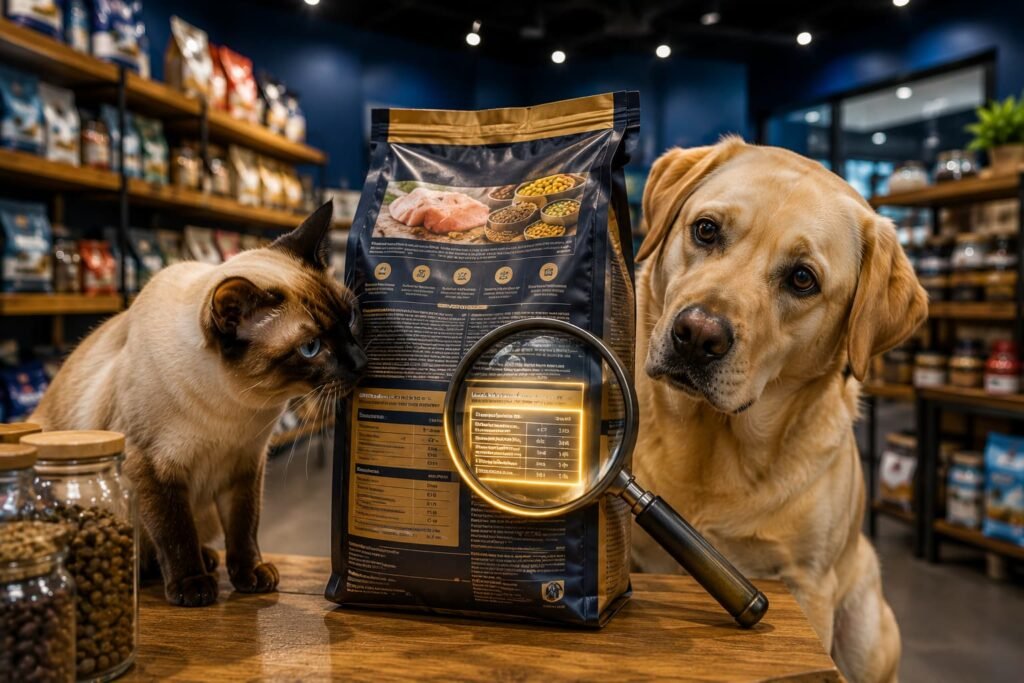
Walk into a pet store and look at the food aisle.
Suddenly, choosing dinner for your pet feels like reading a chemistry textbook while standing under fluorescent lights.
“Premium.”
“Natural.”
“Holistic.”
“Grain-free.”
“High protein.”
“Real meat.”
The packaging makes impressive promises.
But here’s the question that actually matters:
Is the food inside the bag nutritionally appropriate for your pet?
The answer isn’t hidden in the biggest words on the front of the package.
It’s usually found in the smaller print on the back.
Learning how to read a pet food label can help you make a more informed decision and avoid being distracted by marketing claims.
Here are 8 things you should check before buying pet food.
This may be one of the most important things on the package.
Look for a nutritional adequacy statement indicating that the food is complete and balanced for the appropriate species and life stage.
In the United States, many commercial pet foods use nutritional profiles established by the Association of American Feed Control Officials (AAFCO).
A complete and balanced food is intended to provide the nutrients required for the specified life stage when fed according to the product’s directions.
This is far more meaningful than simply seeing words like “premium” or “natural.”
Marketing tells a story.
Nutritional adequacy tells you what the food is actually formulated to provide.
This sounds obvious.
Yet it’s surprisingly important.
Dog food and cat food aren’t nutritionally interchangeable.
Cats have specific nutritional requirements that differ from dogs, including requirements for nutrients such as taurine and preformed vitamin A.
Likewise, food formulated for puppies may not have the same nutritional profile as food intended for adult dogs.
Before analyzing anything else, check:
Is this food actually formulated for my pet?
The correct species and life stage come first.
A puppy isn’t simply a smaller adult dog.
A kitten isn’t merely a tiny cat.
Growing animals have different nutritional requirements because their bodies are developing rapidly.
Look for language indicating whether the food is intended for:
For puppies, especially large and giant breeds, appropriate nutritional formulation is particularly important because excessive energy intake and inappropriate mineral balance can affect skeletal development.
Choose food based on the animal in front of you, not the puppy they will eventually become.
The ingredient list can tell you what ingredients are included, but it doesn’t tell the entire nutritional story.
Ingredients are generally listed in descending order by weight before processing.
That means the first several ingredients can give you useful information about the composition of the product.
However, ingredient lists can be misleading if interpreted without context.
For example, meat meals are concentrated sources of protein because much of their water has been removed.
Likewise, grains aren’t automatically “fillers,” and by-products aren’t automatically poor quality.
The important question is whether the finished product provides complete and balanced nutrition.
Don’t judge a book by its cover.
And don’t judge a pet food by one ingredient.
The guaranteed analysis provides information about certain nutrients in the food.
Depending on the product, this may include:
These numbers can be useful when comparing products, but there is an important complication:
Different foods contain different amounts of water.
A dry food and a canned food cannot always be compared directly by looking at the percentages on the label.
For example, a wet food may appear lower in protein simply because it contains much more water.
When making serious nutritional comparisons, veterinarians and nutrition professionals may compare nutrients on a dry matter basis.
This prevents water from distorting the numbers.
Calories matter.
A lot.
Two foods can both look healthy while providing very different amounts of energy per cup or can.
If your dog needs approximately 500 calories per day and one food provides 350 calories per cup while another provides 500, feeding the same volume of each would produce a very different calorie intake.
This becomes particularly important for:
Look for the calorie statement, often expressed as kcal per cup, can, or kilogram.
And remember:
Treats count too.
Your pet doesn’t understand that the tiny biscuit was “only a snack.”
Calories are still calories.
Feeding instructions are useful starting points, but they aren’t absolute laws.
Your pet’s actual calorie needs can vary based on:
A highly active working dog may require substantially more energy than a sedentary companion dog of the same weight.
Start with the label’s recommendation and monitor your pet’s body condition.
If your pet is gaining weight, the feeding amount may need adjustment.
If they’re losing weight unexpectedly, something else may be happening and veterinary evaluation may be appropriate.
The front of the bag is designed to make you stop.
The back is designed to make you read.
Words such as:
can be useful descriptors, but they don’t automatically prove that a product is nutritionally superior.
A beautiful photograph of roasted meat doesn’t tell you whether the food is complete and balanced.
Neither does a green leaf.
Nor a mountain.
Nor a dog staring heroically into the distance.
The most important information is usually much less glamorous.
Read the nutritional adequacy statement, calorie information, feeding directions, ingredient list, and guaranteed analysis.
Grain-free diets became extremely popular because many consumers assumed that grains were inherently unhealthy for dogs.
But grains aren’t automatically harmful.
Dogs can digest and utilize properly processed grains, and grains can provide carbohydrates, nutrients, and fiber.
More importantly, grain-free doesn’t automatically mean healthier.
The FDA has investigated reports of canine dilated cardiomyopathy associated with certain diets, many of which were labeled grain-free and contained high proportions of peas, lentils, other legumes, or potatoes.
The relationship is complex and continues to be studied.
If you’re considering a grain-free diet for your dog, discuss the decision with your veterinarian rather than choosing it simply because the packaging says “grain-free.”
Not necessarily.
A long ingredient list isn’t automatically a sign of poor quality.
Likewise, a short ingredient list isn’t automatically proof of superior nutrition.
Some ingredients perform specific nutritional or functional roles.
The goal isn’t to find the shortest list.
The goal is to find a food that provides appropriate, complete nutrition for your individual pet.
Not automatically.
The word “by-product” has developed a somewhat frightening reputation among pet owners, but animal by-products can include nutrient-rich organs and tissues.
Some organ meats naturally contain valuable vitamins and minerals.
What matters is the specific ingredient, its source, the formulation, and the nutritional adequacy of the final food.
A properly formulated food containing animal by-products isn’t automatically inferior to a food that doesn’t.
Not necessarily.
Preservatives help prevent food spoilage and maintain nutritional quality.
Some pet owners prefer certain preservation methods, but the presence of a preservative doesn’t automatically mean the food is unsafe.
The more useful approach is to evaluate the entire formula and the manufacturer’s quality and safety practices.
A good pet food should be:
Appropriate for the species.
Appropriate for the life stage.
Complete and balanced when intended as a sole diet.
Appropriate in calorie density.
Produced by a reputable manufacturer with appropriate quality-control practices.
Suitable for your individual pet’s health needs.
This last point is important.
A food can be perfectly nutritious for one animal and inappropriate for another.
A dog with kidney disease, for example, may need a very different nutritional strategy from a healthy adult dog.
A cat with urinary problems may require a specialized diet.
Nutrition isn’t one-size-fits-all.
Before buying a new food, ask:
Dog food for dogs. Cat food for cats.
Puppy, adult, kitten, senior, pregnancy, or another specific category.
Check the nutritional adequacy statement.
Consider the calorie density, not just the portion size.
Look at protein, fat, fiber, and moisture in context.
Look at the whole formula, not one ingredient.
Use the feeding directions as a starting point and monitor body condition.
Consider age, activity, weight, allergies, and medical conditions.
Choosing pet food doesn’t require a degree in veterinary nutrition.
But it does require looking past the marketing.
Instead of asking only:
“Does this food look healthy?”
ask:
“Is this food complete, balanced, appropriate for my pet, and suitable for their individual needs?”
Check the nutritional adequacy statement.
Look at calories.
Read the ingredient list in context.
Consider the guaranteed analysis.
Pay attention to life stage.
And don’t let a photograph of perfectly roasted chicken make your nutritional decisions for you.
Your pet deserves better than marketing.
They deserve a bowl that actually meets their nutritional needs.
Important: This article is for general educational purposes and does not replace veterinary advice. Pets with allergies, obesity, kidney disease, urinary disorders, gastrointestinal disease, or other medical conditions may require individualized nutritional recommendations from a veterinarian or veterinary nutritionist.